
How the Paris Métro works
The Métro has a dense network, with a station often within a 5–10-minute walk in central Paris. For a first journey, focus on three things: your line number, the terminus that indicates your direction and the station where you get off.
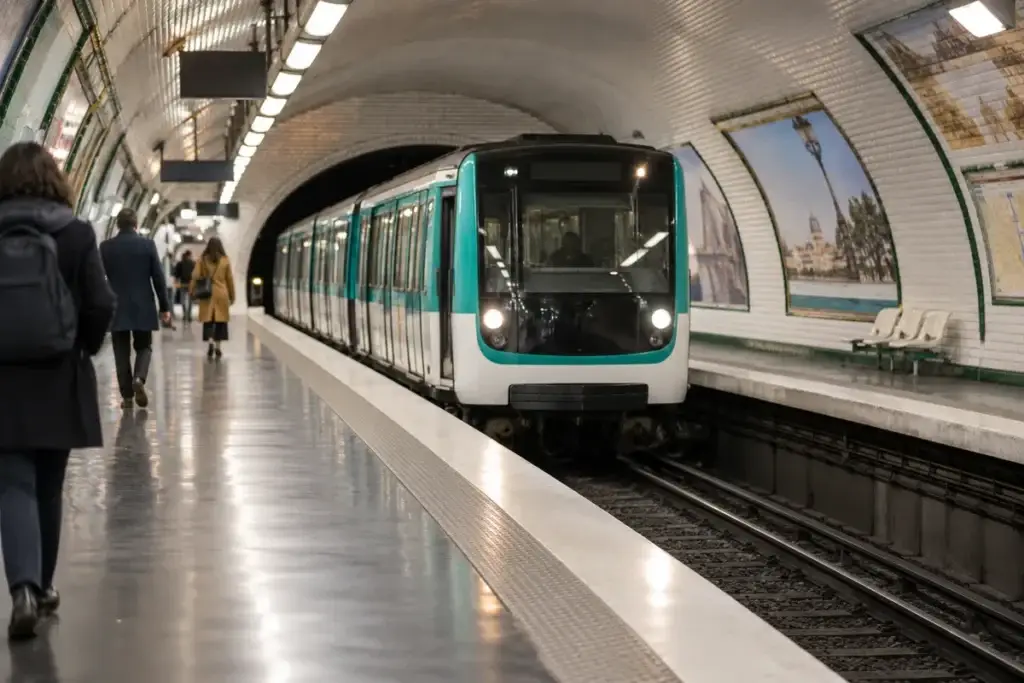
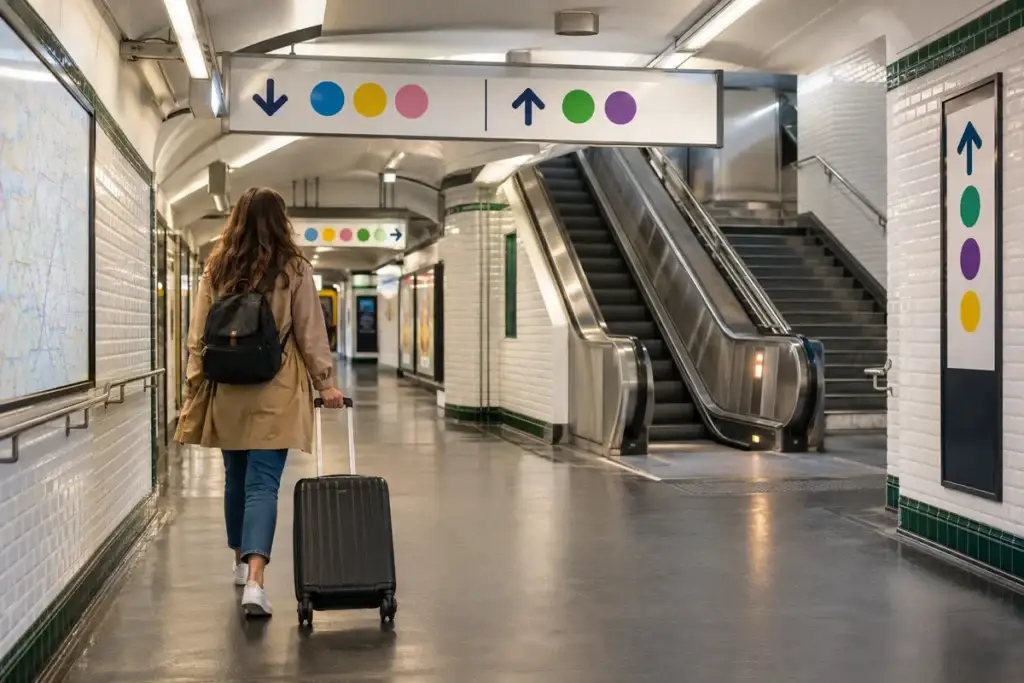
Lines use numbers and colours. Platform signs generally show the line’s final station rather than north or south. Check that terminus as well as the line number to avoid taking the right line in the wrong direction.
Take the Métro to the start of your route, then explore central Paris on foot. Our two-hour Paris introduction helps you get your bearings with a guide. Plan the journey to its stated meeting point in advance.
Which tickets should you buy in 2026?
In 2026, a single Ticket Métro–Train–RER costs €2.55 and a Ticket Bus–Tram costs €2.05 at full fare. They cover different types of journey. Check the official Île-de-France Mobilités fares. For airport travel, check the Ticket Paris Région ↔ Aéroports; for a visitor pass, see Paris Visite. Single-ticket rules are also available from RATP.
For Charles de Gaulle via RER B, or Orly via Métro line 14 or Orlyval, the Ticket Paris Région ↔ Aéroports costs €14 at the full 2026 fare. An ordinary Métro–Train–RER ticket does not replace an airport ticket.
A one-day Paris Visite pass costs €30.60 for an adult at 2026 fares, with options for 2, 3 and 5 consecutive days. Compare the cost with your planned journeys. The pass covers transport, rather than admission to Versailles or a museum.
Navigo Easy, your phone or Paris Visite?
Navigo Easy is a reusable card onto which you can load compatible tickets and validate at the gates. A supported smartphone and app can also be convenient for buying and validating tickets.
Each traveller needs their own valid ticket and card or phone as applicable. Two people cannot travel on one validated ticket. Keep your ticket medium until the journey is complete: inspections can take place on trains, at exits or during connections.
Paris Visite offers the simplicity of a pass for a chosen number of days, but compare costs before buying. For some first visits, single Métro–Train–RER tickets on Navigo Easy or a phone, plus a separate airport ticket when needed, may suit better. Check which ticket types can be stored together on the same medium.
Reading the map and choosing a direction
Before entering, plan your journey with Île-de-France Mobilités, Bonjour RATP, Google Maps or Citymapper. Note both the line number and the terminus for your direction, then look for them on platform signs.
Some connections are long, especially at Châtelet–Les Halles, Montparnasse–Bienvenüe, République and Saint-Lazare. Follow the line numbers and signs rather than looking for an unmarked shortcut.
The Métro–Train–RER ticket permits connections within the Métro, RER and train network for up to two hours without leaving it. Passing through an exit gate ends that journey; buses and trams require another suitable ticket.
Connections, RER trains and airports
RER trains serve Paris and its suburbs. RER A crosses the city east–west, RER B runs north–south and RER C follows the Seine and serves Versailles. Check branches carefully: trains on the same line may have different destinations. For Versailles, allow time to reach the town and walk to the meeting point. If taking our guided Versailles Palace visit, plan around the confirmed meeting address and start time.
Check the destination as well as the line letter. Platform displays show the stations each RER train serves. If your station is not listed or illuminated, wait and confirm before boarding.
Use the appropriate airport ticket for Charles de Gaulle on RER B or Orly via line 14 or Orlyval, depending on your route. After a flight, a simpler connection may be easier with luggage, especially at peak times.
Safety and common mistakes
Watch your belongings around station entrances, escalators, crowded carriages and major interchanges. Keep your bag where you can see it, your phone secure and documents away from outer pockets.
Buy from official machines, apps or station staff rather than people approaching you beside ticket machines. If someone insists on helping, ask a staff member instead. Keep your ticket until you have left the network.
Move inside the carriage rather than blocking the doors. Take a backpack off your back when crowded, and move towards the exit before your stop.
Your first journey, step by step
1. Plan the journey and note the line number. 2. Check the terminus for your direction. 3. Buy or load the right ticket for Métro/RER, bus/tram or airport travel. 4. Validate your card or phone and wait for the green signal. 5. Check the direction again on the platform. 6. Follow internal signs when changing lines. 7. Keep your ticket or card until the journey is complete.